
As a global society, we often hope that with time comes progress: a march toward understanding, unity, and empathy. Yet, recent events involving Haitian immigrants have pulled back the curtain on an uglier, more disturbing reality in which deeply ingrained biases fester. The latest xenophobic attack on the Haitian community is not just an echo of the past but an amplification of dangerous myths that should have long since been buried.
A vile, racially charged narrative has begun to resurface, propagated by pockets of extremists I would call NatioNazists, primarily supported by some Americans and Dominicans who seem determined to smear an already vulnerable population. On social media, specifically X (formerly Twitter), we see this orchestrated attack take shape. What once was dismissed as fringe chatter is now gaining frightening traction: Haitians are being slandered, not just as “animals” in the dehumanizing sense, but as people who eat pets. They are pictured as “pet eaters” — a grotesque and false accusation that goes beyond mere insult and crosses into a chilling realm of hatred and fear-mongering.
This level of propaganda harks back to a long and malicious history of demonizing Black and immigrant populations. The parallels between the horrid claims today and the dehumanizing rhetoric once used by colonial powers are unmistakable.
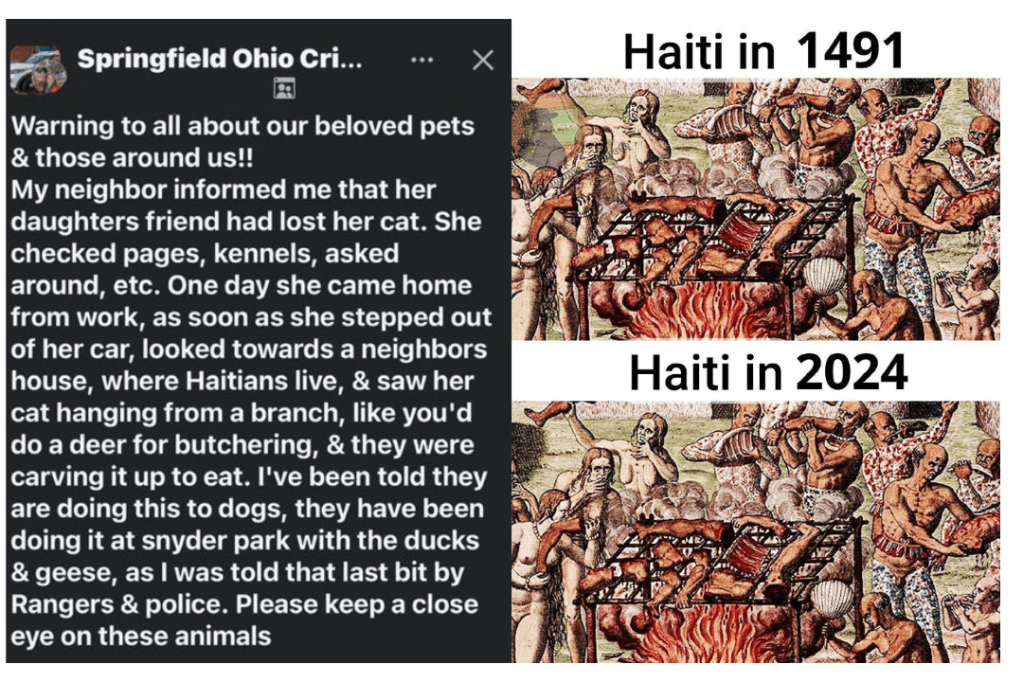
The image circulating from Springfield, Ohio, is especially repugnant. It spins a tale of animal cruelty — where Haitian immigrants are grotesquely depicted as cat-eaters — invoking a modern-day caricature of savage barbarism. Accompanying this hateful rhetoric are crude historical illustrations, contrasting Haiti “in 1491” with Haiti “in 2024,” reinforcing the falsehood that the country and its people are somehow unchanging in their brutality. The underlying message is clear: these people are to be feared, dehumanized, and ostracized.
But this false narrative does more than slander; it seeks to drive a wedge between immigrant communities and their neighbors. By stoking fear, such grotesque imagery and stories try to justify the exclusion, mistreatment, and even violence toward Haitians.
The real question is: why now? Why this sudden resurgence of hate?
For years, Haitians have faced discrimination both within the United States and in neighboring countries like the Dominican Republic. But as national conversations evolve around crime, mass shootings in schools, in churches, and at concerts, there’s an emerging realization that these issues are not tied to immigration as some have long claimed. The face of criminality in America does not look like the immigrants they want to vilify. So, when they can no longer point fingers at Haitians for shootings in schools, churches, or concerts, they concoct another narrative: one of dehumanization.
In essence, this is about power. It’s about fear of the “other” and, for those who subscribe to these supremacist ideologies, maintaining dominance by any means necessary — even if it means fabricating outrageous lies about Haitian people.
These NatioNazists, a term that captures their poisonous blend of nationalism and racism, are pushing a campaign that seems designed to stir hatred and provoke violence, especially from Americans and Dominicans who see the growing Haitian immigrant population as a threat. The same tired tactics of scapegoating, fear-mongering, and cultural demonization are being dusted off and repackaged for the 21st century, with social media serving as a megaphone.
So, how should the Haitian community respond to such heinous and slanderous attacks?
 NouvoVwa
Leave a comment